
Emily and Richardson Preyer Buckridge Reserve
Learn more about safety tips and the reserve rules and policies before your visit.
Camping and campfires are not permitted at this site.
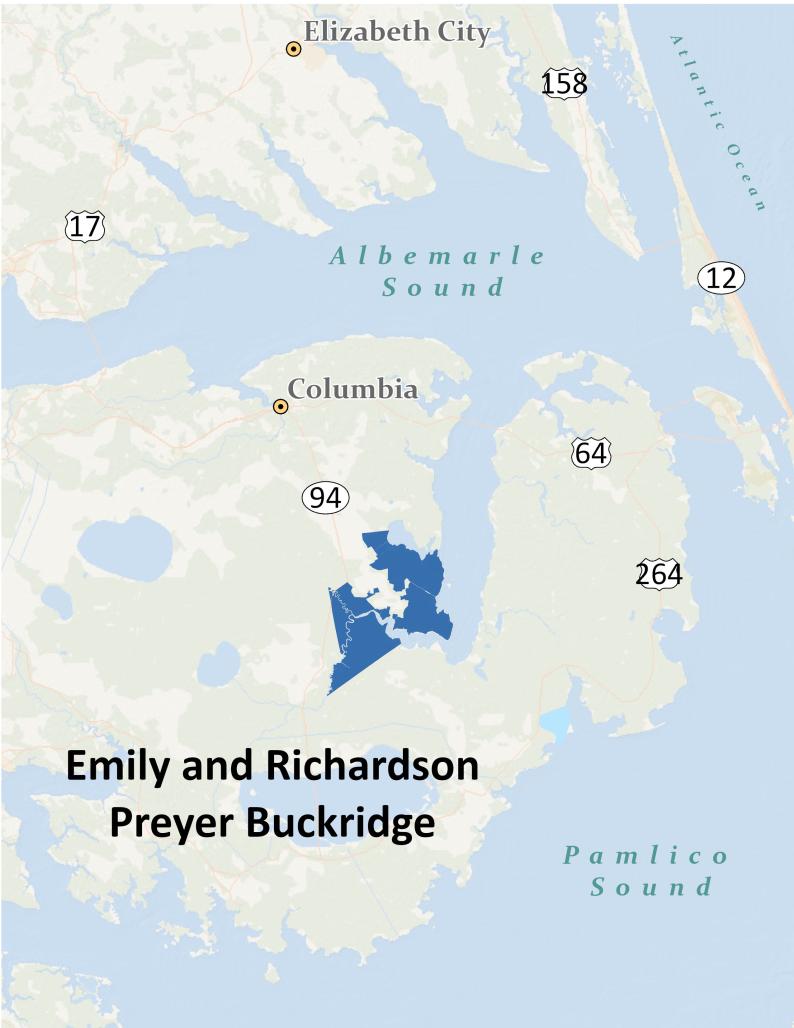
The Buckridge Reserve is located along the southwestern shore of the Alligator River, adjacent to the community of Gum Neck.
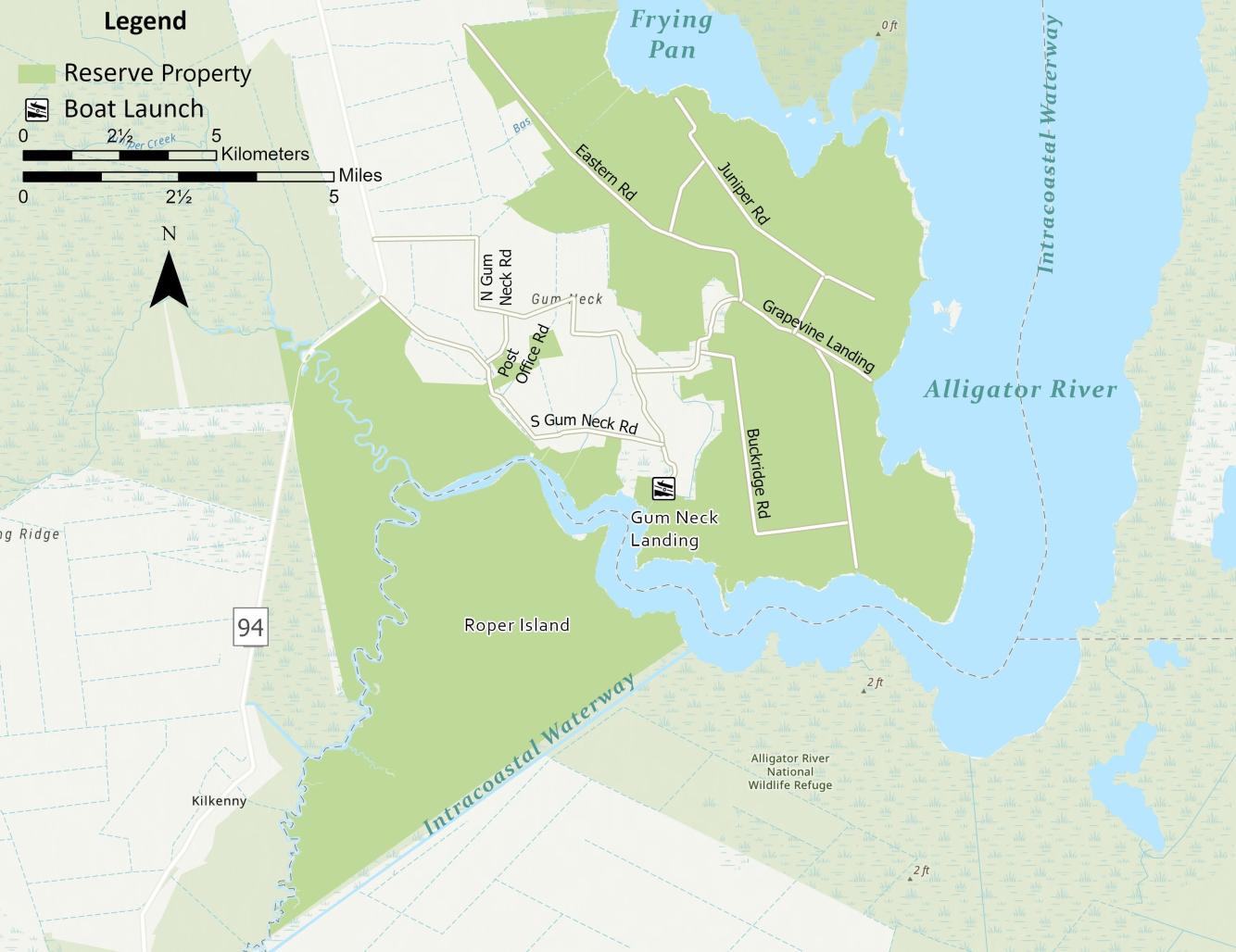
It may be accessed from N.C. 94 by way of U.S. 64 in Columbia. Traveling south on N.C. 94, three routes give a visitor access to different portions of the site. Fifteen miles south of Columbia, N.C. 94 intersects with N. Gum Neck Road, which leads to Grapevine Landing Road. It bisects much of the Reserve and offers the easiest way to get a glimpse of Buckridge for visitors by car.
For visitors with a boat, Frying Pan Landing is approximately 10 miles south of town, while Gum Neck Landing is further south in the community of Gum Neck. Both are N.C. Wildlife Resources Commission ramps and free to the public.
Please note:
- Certain roads are opened to traffic during the fall hunting season for ease of access. Roads may be closed at times during the hunting season to protect the resource.
- Driving on gated roads is at your own risk.
- Blocking roads, gates, or otherwise preventing traffic flow is prohibited.
Yes. The reserve is open to visitors year round. Visit at your own risk. The site is remote and conditions can include natural hazards such as biting insects, poisonous plants, and venomous snakes.
Natural Features
At 29,335 acres, the Emily and Richardson Preyer Buckridge Reserve is both the largest single property in the Coastal Reserve and its only inland site. Located approximately 15 miles south of Columbia in Tyrrell County, the site is situated between Alligator River and Pocosin Lakes National Wildlife Refuges. This site is also a Dedicated Nature Preserve, authorized by G.S. 143B-135.250.
This Reserve site is part of the East Dismal Swamp, a wetlands complex that encompasses more than 320,000 acres in Dare, Tyrrell, and Washington counties. The majority of the site contains non-riverine swamp forest, peatland Atlantic white cedar forest, and pond pine woodlands.
Scattered remnant bald cypress and Atlantic white cedar stands occur in deep organic soils, while sweet gum grows in the rare mineral soils and black needle rush rims the perimeter of the site. Most of the oldest Atlantic white cedar forest has been cut, but there is an area of about 4,000 acres that represents the most extensive contiguous example of this forest type in the state. Buckridge maintains habitat for several rare, threatened, or endangered species. Confirmed rare species on site include the red wolf, red-cockaded woodpecker, bald eagle, American alligator, timber rattlesnake, and pigmy rattlesnake. Habitat for Atlantic and shortnose sturgeons, and high priority neotropical migrant birds is also maintained at Buckridge. Certain migratory birds, such as the black-throated green warbler, Swainson’s warbler, and prothonotary warblers, are dependent on southeastern-forested wetlands of the coastal plain for breeding.
Nonriverine Swamp Forest
Seasonally flooded wetlands not associated with rivers, they occur on moderate to deep peat soils. The canopy is dominated by red maple and swamp black gum, with lesser amounts of loblolly pine and bald cypress. All age classes of this community are present
at Buckridge. The understory ranges from open to dense, with sweetbay magnolia, swamp bay, swamp titi, fetterbush, and sweet pepperbush commonly found. This community type has several large examples in N.C.; but most are very close to sea level, and at risk of being lost to rising water levels.
Peatland Atlantic White Cedar Forest
These wetland forests are dominated by their namesake tree, occurring on poorly drained organic soils not flooded by rivers. Soils are often embedded with fallen logs, which may persist for centuries due to the rot resistance of Atlantic white cedar and the waterlogged peat soils. A globally rare community, most examples in NC are shrinking. Logging and unique regeneration requirements are the primary causes. A 4,000 acre stand at Buckridge is likely the largest patch of this community in the state.
Pond Pine Woodland
Pond pine and loblolly bay dominate the canopy. Pond pine woodlands typically possess a tall, dense shrub layer, often greater than 15 feet high. Species of the shrub layer include swamp titi, gallberry, fetterbush, maleberry, swamp redbay, and sweet pepperbush. This community is typically not as wet as others at Buckridge, and is more adapted to fire, with much of the vegetation readily resprouting or releasing seed afterward.
Low Pocosin
Low Pocosins are communities of short shrubs on the deepest peats, as much as 14 feet at Buckridge. Low soil fertility and high wetness stunt plant growth, with scattered pond pine restricted to ¼ their normal size. The dense shrub layer is composed mostly of fetterbush, gallberry, and honeycups, with laurel-leaved greenbrier mixed in. Where the shrub layer becomes sparse, Pocosin Opening community types take hold.
Pocosin Opening - Pitcher Plant Subtype
Pocosin Openings are small patch communities of deep peats, occurring at Buckridge within the Low Pocosin. The Pitcher Plant Subtype is identified by the numerous yellow pitcher plants present, with most other vegetation limited to dwarf shrubs and herbs. Other carnivorous plant species present include purple pitcher plant, spoonleaf sundew, and bladderwort. This community type is critically imperiled and is endemic to North Carolina. Other notable species include switchcane, leatherleaf, chalky bluestem, Walter’s sedge, Virginia cottongrass, and fringed yelloweyed
grass in a bed of sphagnum.
Tidal Cypress-Gum Swamp
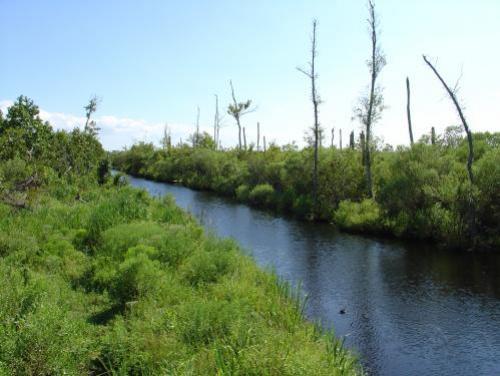
Along the edge of the freshwater side of estuaries, it is flooded by wind tides at Buckridge. Bald cypress and tupelo dominate the canopy, sometimes with loblolly pine, and red maple. Understory may include swamp redbay, sweetbay magnolia, red cedar, and Carolina ash. Shrub layer may feature wax myrtle, swamp titi, highbush blueberry, swamp rose, and switchcane. At Buckridge, this community transitions into tidal freshwater marsh or open water as one approaches the river. Dieback from storm events transform this habitat into ghost forests at Buckridge.
Estuarine Fringe Pine Forest - Pond Pine Subtype
These are strongly pine-dominated woodlands adjacent to marshes that are almost always wet. This is an emerging community type at Buckridge, where former Pond Pine Woodlands have converted with changes in the nearby estuary. This community does not experience
normal tidal flooding. The shrub layer consists mainly of wax myrtle, though swamp bay, and inkberry may be abundant. Other typical pocosin shrubs are largely absent, and species associated with tidal freshwater marshes are usually present.
Mammals
Larger mammal species found on site include bobcat, black bear, beaver, river otter, white-tailed deer, raccoon, Virginia opossum, and gray fox. Red wolves occur in and around the reserve, but these endangered predators are secretive and rarely seen.
Reptiles & Amphibians
A wide variety of these species occur on site, but comprehensive inventories have yet to be performed. Dozens of species of turtle, lizard, snake and amphibian have been observed. American alligators occur at Buckridge, but are typically shy and difficult to observe.
Canebrake rattlesnake, copperhead, water moccasin, and pigmy rattlesnake are venomous species seen at Buckridge. Pigmy rattlesnakes in this area have an
unusual pinkish to red coloration.
Birds
Notable species include the red-cockaded woodpecker, bald eagle, wood duck, prothonotary warbler, barred owl, and wild turkey. Bird species composition in the forest is seasonal, with Buckridge hosting numerous migratory species.
Standing dead timber in parts of Buckridge provide nest sites for cavity nesters. The endangered red-cockaded woodpecker is an unusual cavity nester, only nesting in living pine trees.
Frequently Asked Questions
- Fires, fireworks, target shooting, nudity, and camping are prohibited.
- Producing noise that is disruptive to wildlife or other visitors is prohibited.
- Removal or disturbance of plants, animals, fungi, or cultural resources is prohibited.
- Littering is prohibited. Leaving any personal property unattended within the boundaries longer than 24 hours is prohibited.
- Written authorization is required for organized events, commercial activities, and other special activities.
The Emily and Richardson Preyer Buckridge Coastal Reserve is named in honor of the late Emily and Richardson Preyer for their commitment to public service, the environment, education, and the arts.
Hunting in the game land portion of Buckridge is allowed according to the N.C. Wildlife Resources Commission regulations for 3-day game lands. The site is part of the N.C. Game Lands Program. Both hunters and visitors should use appropriate caution. Regulations and details about hunting seasons can be found on the NC Wildlife Resources Commission's website. Hunters should review the Buckridge game land boundaries before visiting the site to identify where hunting is allowed.
Primary game sought includes white-tailed deer, black bear, and turkey.
There are no facilities at the Buckridge Reserve.
Off-leash pets are prohibited except dogs engaged in a lawful hunt.
In 1994 the Coastal Futures Committee identified certain types of coastal habitats that were underrepresented among preservation interests. In 1997, the Buckridge tract was offered for sale which was ideal in that it contained several under-represented coastal habitats in an inland setting. Its
acquisition protected the outstanding resource waters of the Alligator River, and helped connect the Alligator River and Pocosin Lakes National Wildlife Refuges. The Nature Conservancy, N.C. Land and Water Fund, and the U.S. Fish and Wildlife Service all provided funding or assistance toward the creation of this reserve.
The Emily & Richardson Preyer Buckridge Reserve is managed by the N.C. Division of Coastal Management to protect the site's ecosystems for research, education, and compatible traditional uses. Support from the N.C. Wildlife Resources Commission for road maintenance and wildlife management is gratefully acknowledged. This site is a three-day per week game land and Dedicated State Nature Preserve.
The North Carolina Coastal Reserve & National Estuarine Research Reserve is a part of the N.C. Division of Coastal Management, within the N.C. Department of Environmental Quality.
This natural area is one of ten sites that make up the North Carolina Coastal Reserve & National Estuarine Research Reserve. Preservation of the Buckridge Reserve allows this representative coastal ecosystem to be available in perpetuity as a natural outdoor laboratory where scientists,
students, and the general public can learn about coastal processes, functions, and influences that shape and sustain the coastal area. Traditional uses, including recreation, are allowed as long as they do not disturb the environment, organisms, or research and educational activities.