
Bald Head Woods Reserve
Visiting the Site
Learn more about safety tips and the reserve rules and policies before your visit.
Camping and campfires are not permitted at this site.
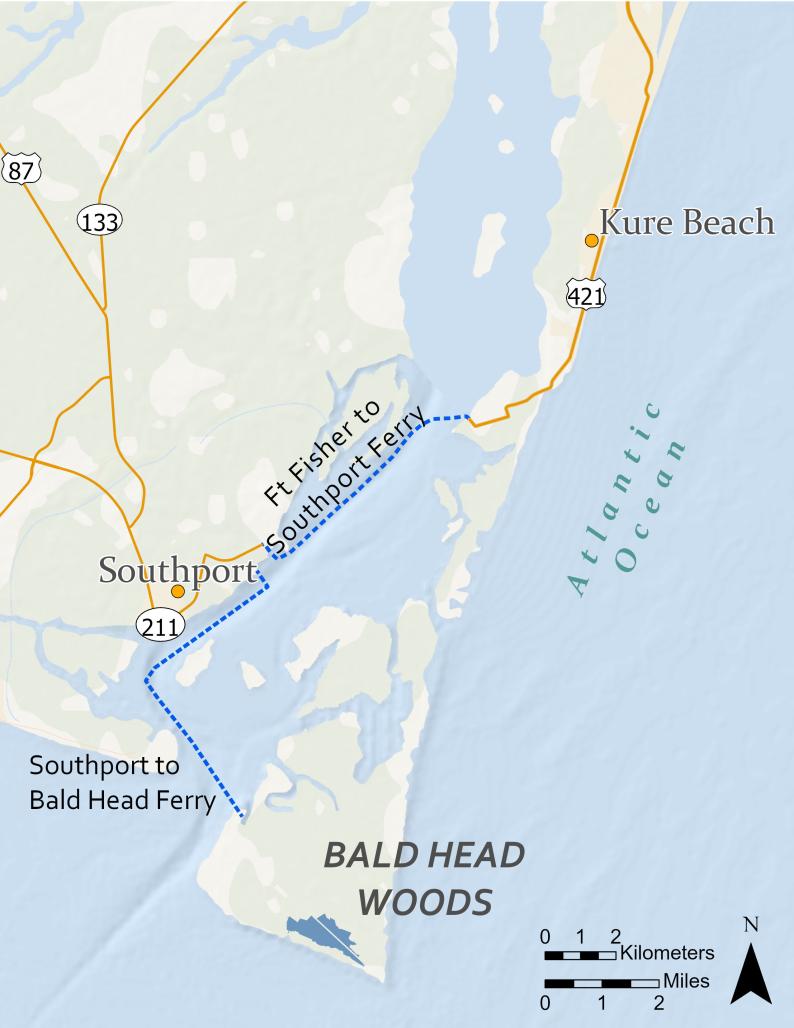
Yes. The Bald Head Woods Reserve is located on Bald Head Island, an island off the coast of N.C. in Brunswick County. The island may be accessed by a 20-minute commercial passenger-only ferry ride that departs from Deep Point Marina in Southport. Tickets can be purchased online or day of at the ticket window. Cars are not allowed on the island, but bicycles and golf carts are available for daily rental at the Bald Head Marina. The reserve site is two miles from the marina along Federal Road. A network of trails can be accessed from multiple golf cart parking areas and trail heads along Federal Road. Ferry schedules and rates are available at (910) 457-5003.
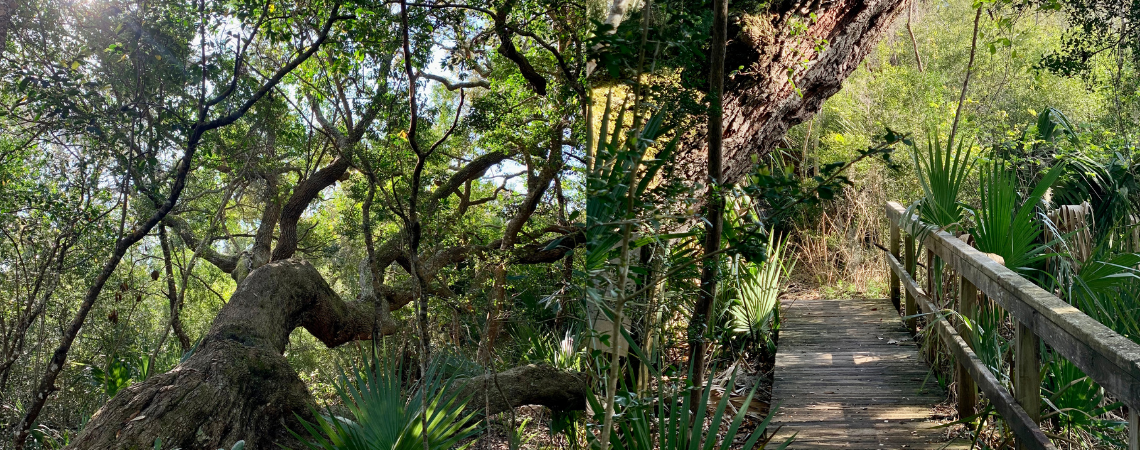
The trail system at Bald Head Woods is primitive with uneven surfaces. They provide an immersive experience into a maritime forest. Depending on the time of year and current conditions, you may encounter biting insects (ticks, mosquitos, etc.), poisonous plants (ie. Poison ivy), and occasional trail hazards (low or downed limbs, exposed roots, etc.). Proper protective clothing and closed toe shoes are encouraged.
Trails
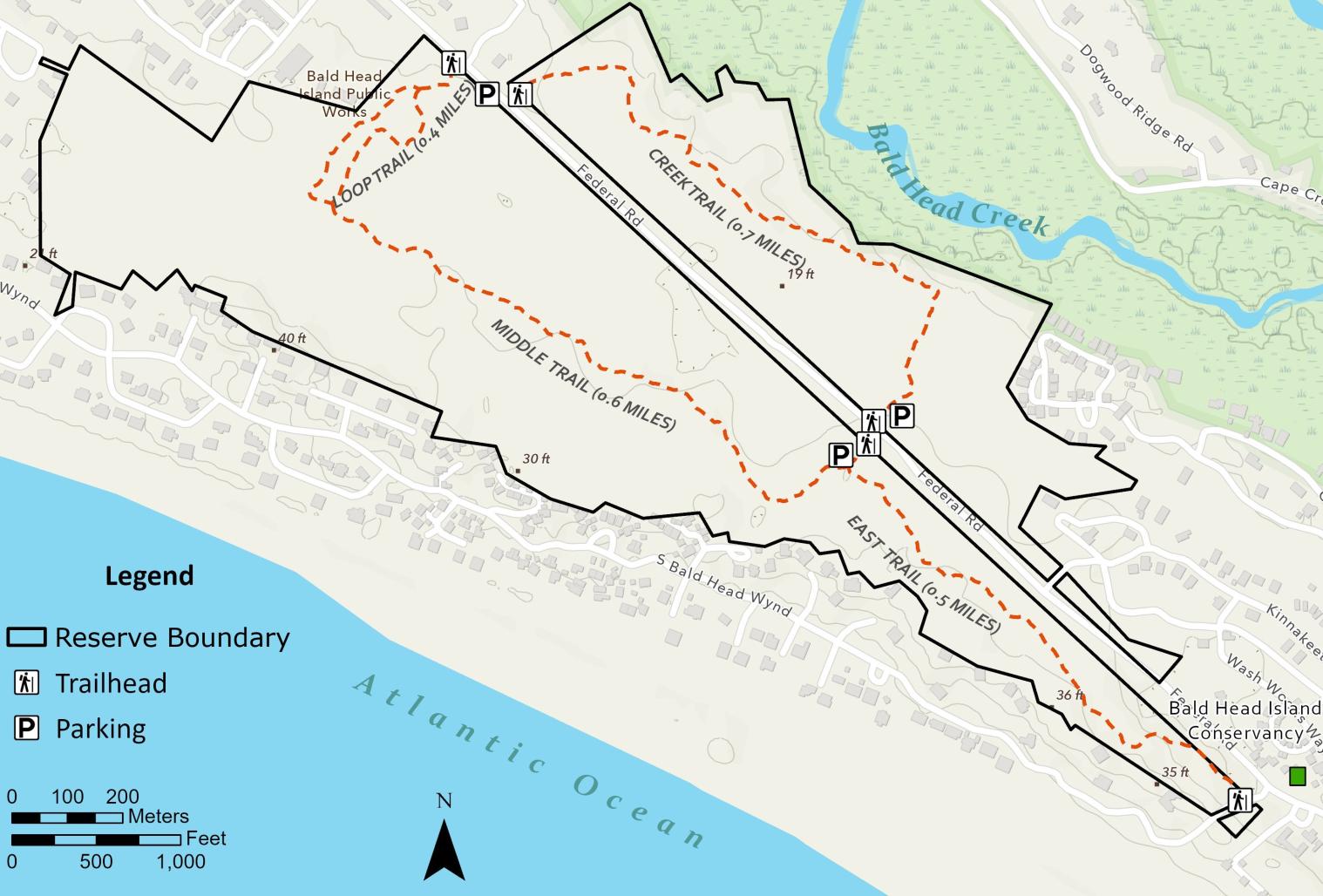
Easy: Loop Trail (0.4 mi) & Middle Trail (0.8 mi)
Easy to Moderate: East Trail (0.5 mi) & Creek trail (0.7 mi)
Parking
Three golf cart parking decks are available on Federal Road to access the reserve at the head of Loop Trail, the foot of Middle Trail, and the head of Creek Trail.
- The reserve is open to visitors year round.
- Visit at your own risk. The site is remote and conditions can include natural hazards such as insects and poisonous plants.
- Off-leash pets are prohibited.
- Fires, fireworks, target shooting, nudity, and camping are prohibited.
- Hunting is prohibited on Bald Head Island.
- Producing noise that is disruptive to wildlife or other visitors is prohibited.
- Removal or disturbance of plants, animals, fungi, or cultural resources is prohibited.
- Littering is prohibited.
- Leaving any personal property unattended within the boundaries longer than 24 hours is prohibited.
- Recreational/off-road motorized vehicles are prohibited.
- Written authorization is required for organized events, commercial activities, and other special activities.
Natural Features
The 191-acre Bald Head Woods component is part of the Smith Island Complex, located just east of the Cape Fear River. This component is bounded on the south and east by the Atlantic Ocean, and on the north by the Zeke’s Island site. This site is also a Dedicated Nature Preserve, authorized by G.S. 143B-135.250.
The “highlands” of this barrier island complex consist of Bald Head, Middle, and Bluff Islands, which are three forested dune ridges separated by salt marshes. The Bald Head Woods component of the North Carolina Coastal Reserve is located in the central portion of Bald Head Island.
One of the significant features of Bald Head Woods is the extremely old, large trees in this maritime forest. Live oak and laurel oak are the major species, comprising a canopy that shelters the plants from salt spray. The thick undergrowth consists of wild olive, American holly, yaupon, and catbrier. The lack of light favors shade-tolerant plants like ebony spleenwort. Cabbage palmetto appears throughout the forest. Gray squirrels, raccoons, and opossums inhabit the forest, as do Carolina wrens, cardinals, and painted buntings. Catbirds, towhees, blue jays, and 22 species of warblers migrate through in the fall.
Live and Laurel Oaks
One of the significant features of the forest is the extremely old, large trees that dominate the canopy. Many of the oaks in Bald Head Woods are hundreds of years old and have diameters over 36 inches.
Cabbage Palmettos
Also known as sabal palmetto, this southern tree species is at the northern extent of its range on Bald Head Island. A tan-gray unbranched trunk and large crown of fan-like leaves make this tree noticeable in the understory and reaching into the canopy of the forest.
Vines
The maritime forest contains numerous vine species that knit the upper branches of the dominant trees together, increasing the protective function of the canopy. Particularly during the fall, poison ivy can cause an unpleasant contact rash if touched. This plant can easily be identi fied by its three-leaf con figuration and the copious amounts of hairy reddish roots which attach its stem to its host tree.
Dune Bluecurls
Dune bluecurls, a significantly rare plant in North Carolina, is a mint that typically grows in small colonies on back dunes. Adapted to disturbed areas, it is also found along roadsides within the reserve.
Mammals
The highly adaptive non-native red fox and coyote have increased in numbers on coastal islands. These clever predators are able to utilize a variety of food sources and have adapted to live in close association with human development. As a result, there have been noticeable impacts to threatened and rare wildlife, including predation to sea turtle and shorebird nests. White-tailed deer are also frequently seen along the trails.
Reptiles and Amphibians
Among the five species of snakes found, the black racer is the most common. Lizard species in the reserve include the six-lined racerunner, five-lined skink, and glass lizard. The interdune ponds are home to frog and toad species including the southern toad, squirrel tree frog, green tree frog, and narrow-mouthed toad.
Birds
At least 60 species of birds use the reserve during migration and 25 species winter on the island. Summer residents include Carolina wrens, cardinals, painted buntings, and 20 species of warblers including: blackburnian, golden-winged, magnolia, mourning, and black-throated blue. The painted bunting is a common summer resident in the dense shrub thickets.
Maritime Evergreen Forest
The dune ridges and slopes within the forest are dominated by live oaks, but host a mix of live and laurel oaks, cabbage palmettos, and loblolly pines, with scattered individuals of red cedar and flowering magnolia. The forest understory contains flowering dogwood, wild olive, Carolina laurel cherry, American holly, wax myrtle, beauty berry, and tough bumelia. Numerous vines are present, including cat brier, summer grape, poison ivy, and peppervine. The trees of the forest canopy are adapted to salt spray and wind shear. These forces acting together give the forest its characteristic sloped shape and serve to create a dense protective canopy over the plants and animals that dwell within the forest. The vast root systems of the forest also provide water purification and soil stabilization functions for the overall benefit of the island's ecosystems and organisms.
Maritime Swamp Forest & Interdune Swales
Scattered areas of local depressions or swales are located between the higher and drier dune ridges and contain seasonally flooded habitats. These swamp forest areas contain plants such as red bays, willows, red maples, musclewood, wax myrtle and cane, as well as vines such as poison ivy and Carolina supplejack. With few examples of this ecosystem type remaining, they are considered to be globally imperiled. Found primarily along the southern border of the reserve, wetter interdune areas hold seasonally to permanently wet ponds that contain herbs such as pennyworts, nettles, sedges, rushes, and netted chain ferns. Shrubs such as the groundsel tree and wax myrtle can be found on the peripheries. These areas are also home to a variety of frogs and toads.
Frequently Asked Questions
Yes, but pets must be on a leash.
Public restrooms are available at the Bald Head Island Conservancy and in the Bald Head Island Marina.
The Bald Head Woods Reserve nature trails pass through upland and wetland habitats representative of local maritime forest communities.
Yes. Beware of biting insects (flies, mosquitoes, ticks, chiggers) and poisonous plants (poison ivy). Sun protection is also advised.
The Bald Head Woods Reserve is managed by the N.C. Division of Coastal Management to protect a portion of the island’s maritime forest for research, education and compatible traditional uses. Support from the Bald Head Island Conservancy for stewardship of the site is gratefully acknowledged. This site is also a Dedicated State Nature Preserve.
The North Carolina Coastal Reserve & National Estuarine Research Reserve is a part of the N.C. Division of Coastal Management, a division of the N.C. Department of Environmental Quality.
This natural area is one of 10 sites that make up the North Carolina Coastal Reserve & National Estuarine Research Reserve. Preservation of the Bald Head Woods maritime forest allows this unique coastal ecosystem to be available in perpetuity as a natural outdoor laboratory where scientists, students, and the general public can learn about coastal processes, functions, and influences that shape and sustain the coastal area. Traditional uses, including recreation, are allowed as long as they do not disturb the environment or organisms or interfere with research and educational activities.
In 1988, the Coastal Resources Commission determined that maritime forest ecosystems should be a high priority for coastal preservation efforts. As a result, the 191-acre Bald Head Woods Reserve was acquired by the state using funds from the Natural Land and Water Fund, the U.S. Fish and Wildlife Service, and through land donations from Bald Head Island Ltd. The N.C. Chapter of the Nature Conservancy and the Smith Island Land Trust were instrumental in the protection of the reserve.
Printable Brochures
Site Map
Site Management
- Management partner: Bald Head Island Conservancy
- Local Advisory Committee
- Management Plan